
Posted on July 7, 2025
Post categories: Architecture In the Media News Timber
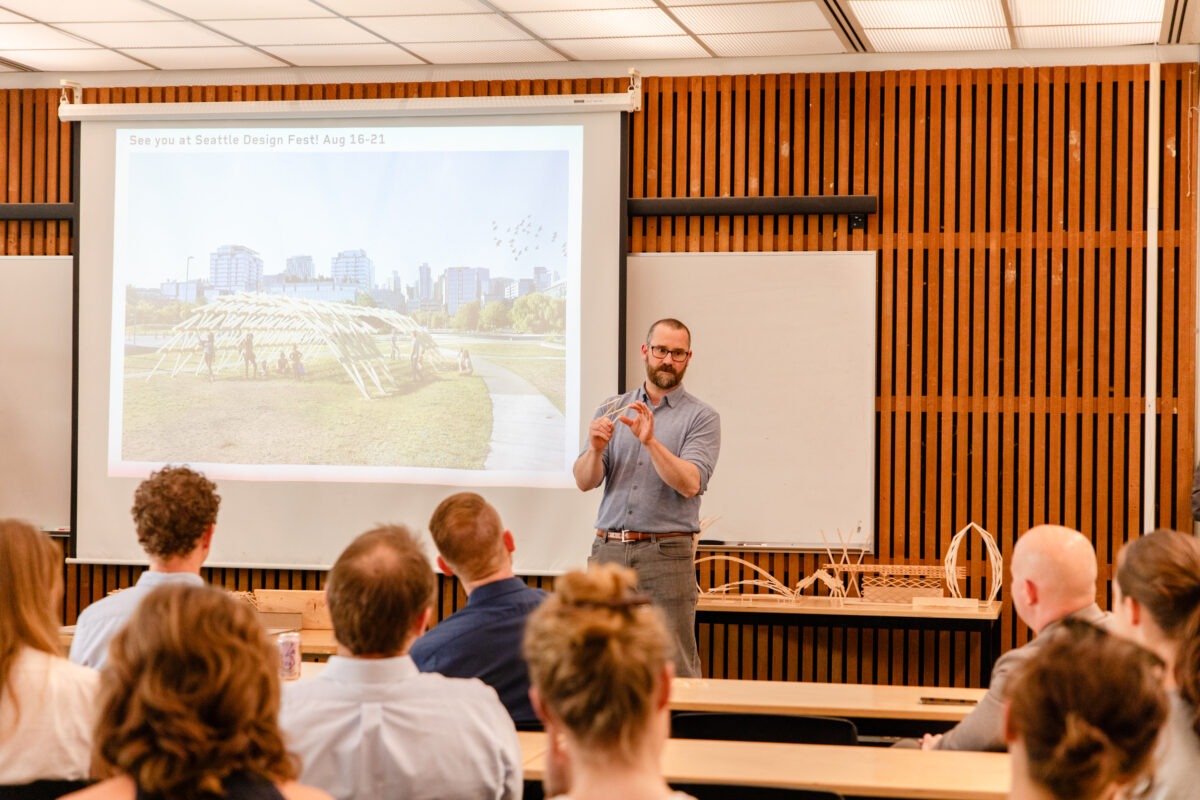
JSTOR Daily recently interviewed Tyler S. Sprague, associate professor and graduate program coordinator in the Department of Architecture at the University of Washington. Trained in both architecture and structural engineering, Sprague studies how these disciplines meet in late 20th- and early 21st-century architecture.
In the feature, he discusses research topics ranging from reinforced concrete skyscrapers in the Pacific Northwest to the engineering behind the 1962 Seattle World’s Fair. He is also the author of Sculpture on a Grand Scale: Jack Christiansen’s Thin Shell Modernism (University of Washington Press, 2019), which explores the pioneering work of structural engineer Jack Christiansen.
Sprague brings this multidisciplinary approach to his teaching. He leads studios in architectural history and structural design and directs the annual Barry Onouye Endowed Studio. In that course, students investigate the design potential of materials such as timber, fabric-formed concrete and tensioned nets.
Looking ahead, Sprague sees timber as a leading material in the future of low-carbon construction. Mass timber, he notes, connects a long cultural history with new opportunities for sustainable design. “There’s so much to learn from the history of wood structures,” he says. “Surrounded by forests, the University of Washington is a great place to explore the past and future of wood structures.”