Posted on January 22, 2026
Post categories: Landscape Architecture News Students Urban Design & Planning
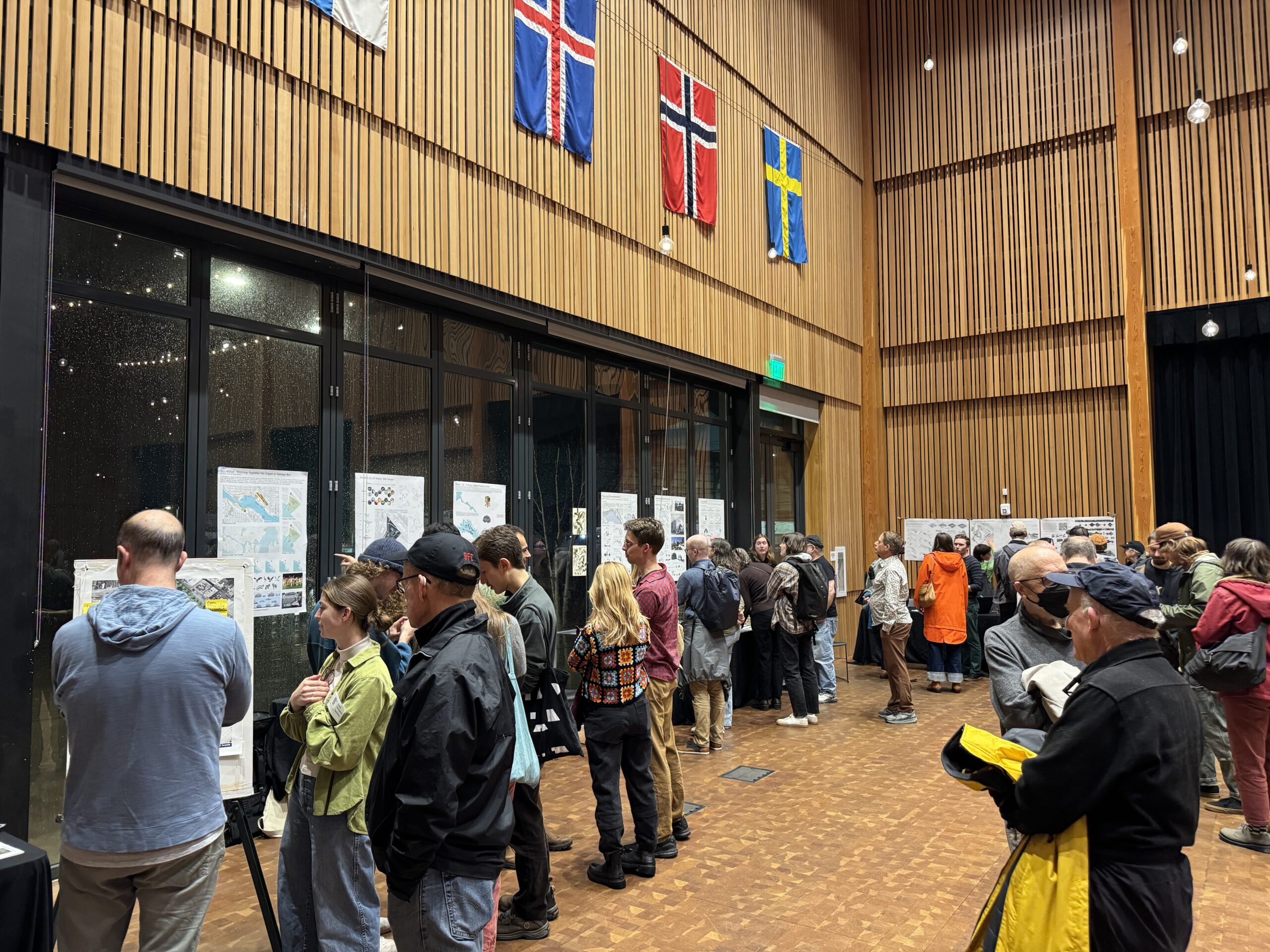
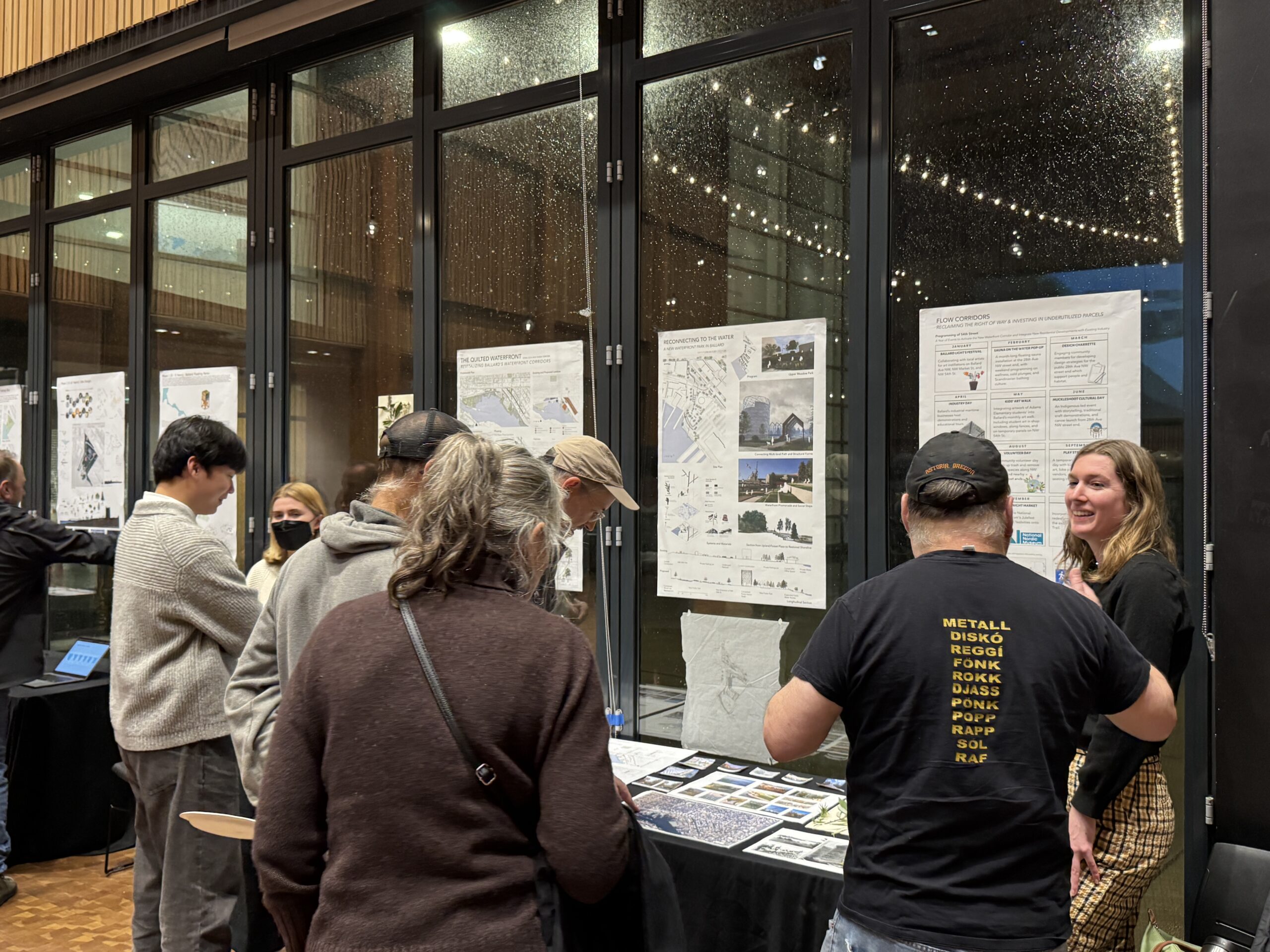
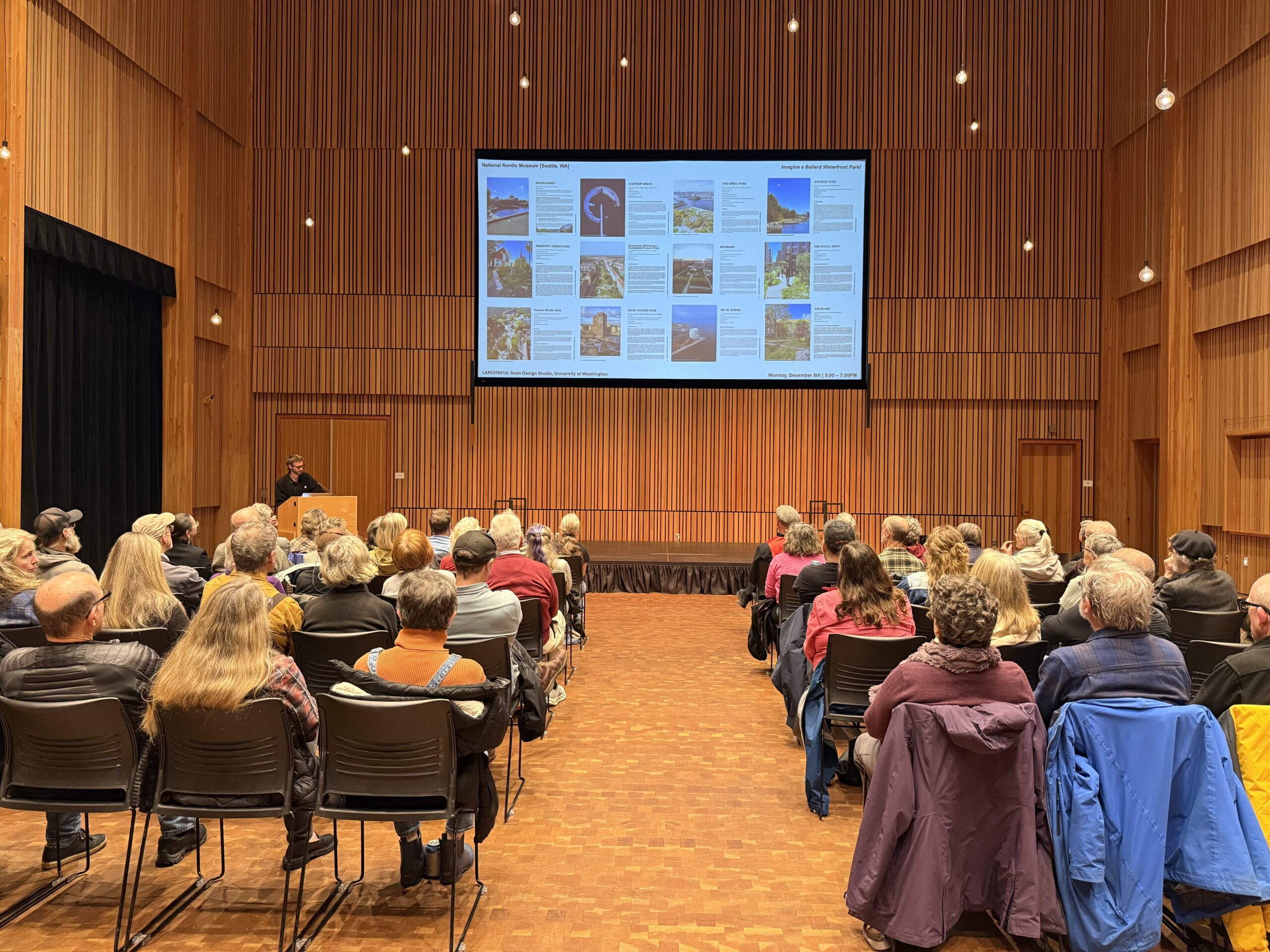
On Monday, December 8, the University of Washington College of Built Environments Scan Design Foundation Interdisciplinary Design Studio brought together students, faculty, and community members at the National Nordic Museum for a public review focused on the future of the Ballard waterfront. The event marked the conclusion of a quarter-long studio and a two-week early fall study abroad in Copenhagen as part of the Scan Design Foundation’s Landscape Architecture and Ecological Urbanism program.
Led by Vincent Javet, assistant teaching professor in landscape architecture, the studio combines international study with interdisciplinary collaboration on local projects. Students work across planning, design, and research to develop proposals that respond to Seattle’s public spaces and waterfronts.
This year, students developed integrated proposals for the former Yankee Diner site near the 24th Avenue NW shoreline street end and the surrounding Salmon Bay. Their work addressed long-term planning frameworks spanning 10 to 25 years, mid-term park and site designs spanning 5 to 10 years, and near-term urban activations spanning 0 to 5 years. The proposals responded to the ecological, industrial, and cultural conditions of the area.
The studio centered on the 24th Avenue NW shoreline street end and adjacent property, a publicly owned but underused connection point between Ballard and Salmon Bay. Adjacent to the site, a Seattle Public Utilities pump station is under construction to manage stormwater and greywater within the watersheds north of the Ship Canal from Wallingford to Ballard.
Often treated only as access infrastructure, the street end and property nearby presents an opportunity to rethink how civic space, ecological systems, and working waterfront uses can exist together. Through near-term interventions, mid-term park design, and long-term planning strategies, students explored how one focused investment could support public access, shoreline resilience, and long-term stewardship.
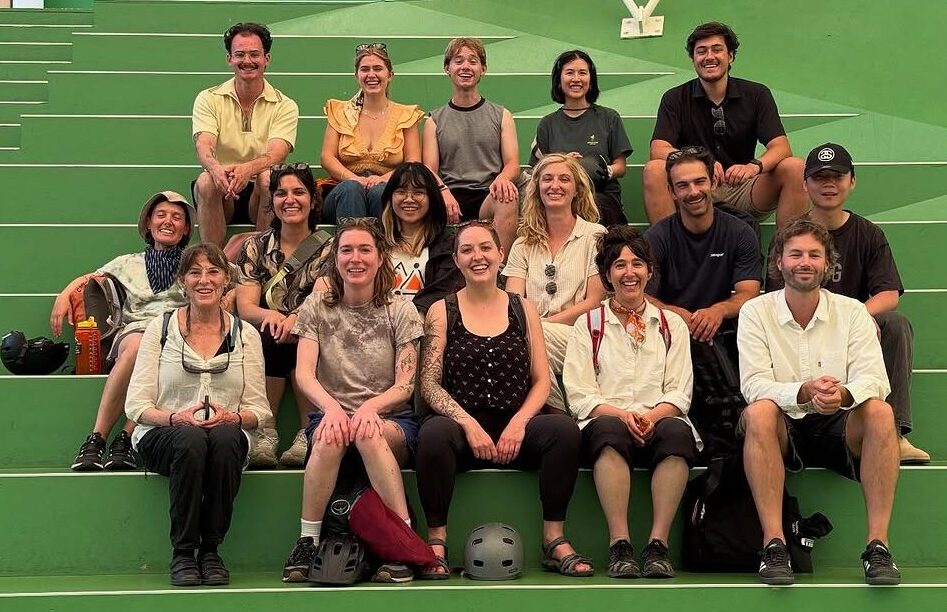
Before the studio, students travel to Copenhagen, Denmark to see the city through its people-centered urban design lens. While abroad, students study precedents in landscape architecture, climate adaptation, and waterfront redevelopment through landscape-led urbanism, biodiversity-focused design, and large-scale ecological planning. Site visits included projects and offices in Copenhagen and Malmö, with engagements at Schulze+Grassov, Gehl Architects, COBE, BIG, and SLA.
These lessons directly informed their work in Seattle. The studio was further supported by Rasmus Astrup, partner and design principal at SLA, who served as distinguished visiting professor during an intensive week in Seattle. His lectures and critiques helped connect Scandinavian approaches to Pacific Northwest conditions.
Back in Ballard, students worked with the Ballard Waterfront Park Coalition, including Groundswell NW, Friends of Street Ends, Washington Water Trails Association and other stakeholders to combine detailed site analysis with historical, cultural, environmental, and social research. This work informed the long-term planning frameworks, mid-term design proposals, and near-term activations presented at the public review.
Students worked with partners across disciplines under the understanding that waterfronts function as ecological systems, cultural landscapes, and places of work and infrastructure. The long-term planning phase was grounded in cultural context and Indigenous knowledge. Stephanie James, cultural director for the Muckleshoot Indian Tribe, met with students at Cannonball Arts to discuss tribal history, contemporary cultural practice, and ongoing relationships to waterfront landscapes.
During the mid-term design phase, the studio collaborated with Jim Graham, principal and founder of Graham Baba Architects. Students toured the firm’s West Canal Yards project and studied adaptive reuse, material choices, and how public access can coexist with active industrial uses.
The studio concluded with a near-term phase focused on temporary urban activations. Environmental artist Buster Simpson guided students in exploring how short-term installations and landscape interventions could test ideas in public, reveal hidden systems, and invite community participation. Projects emphasized adaptable, low-impact approaches that could build momentum and make future possibilities visible.
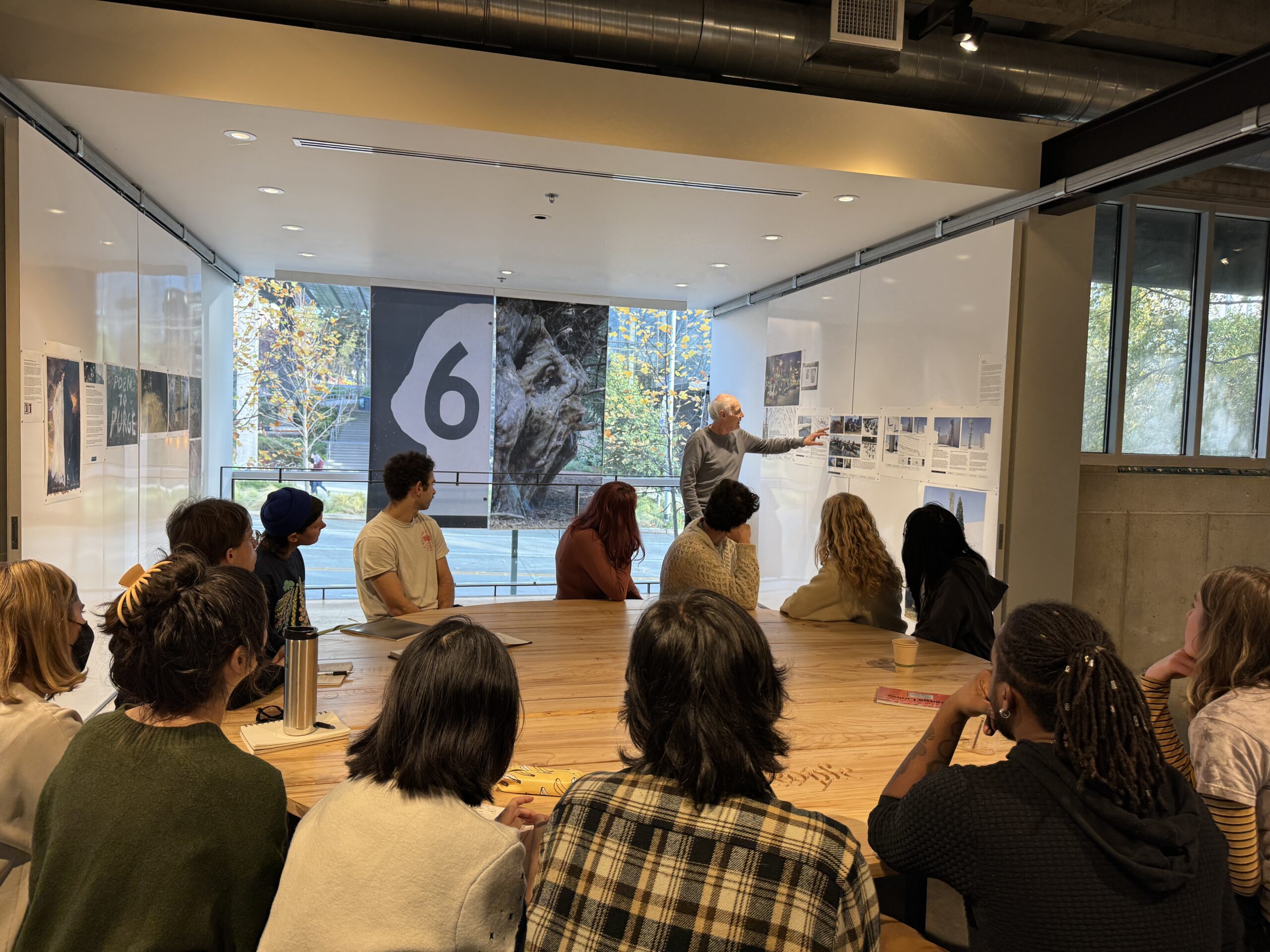
Students working on short-term activations with Buster Simpson
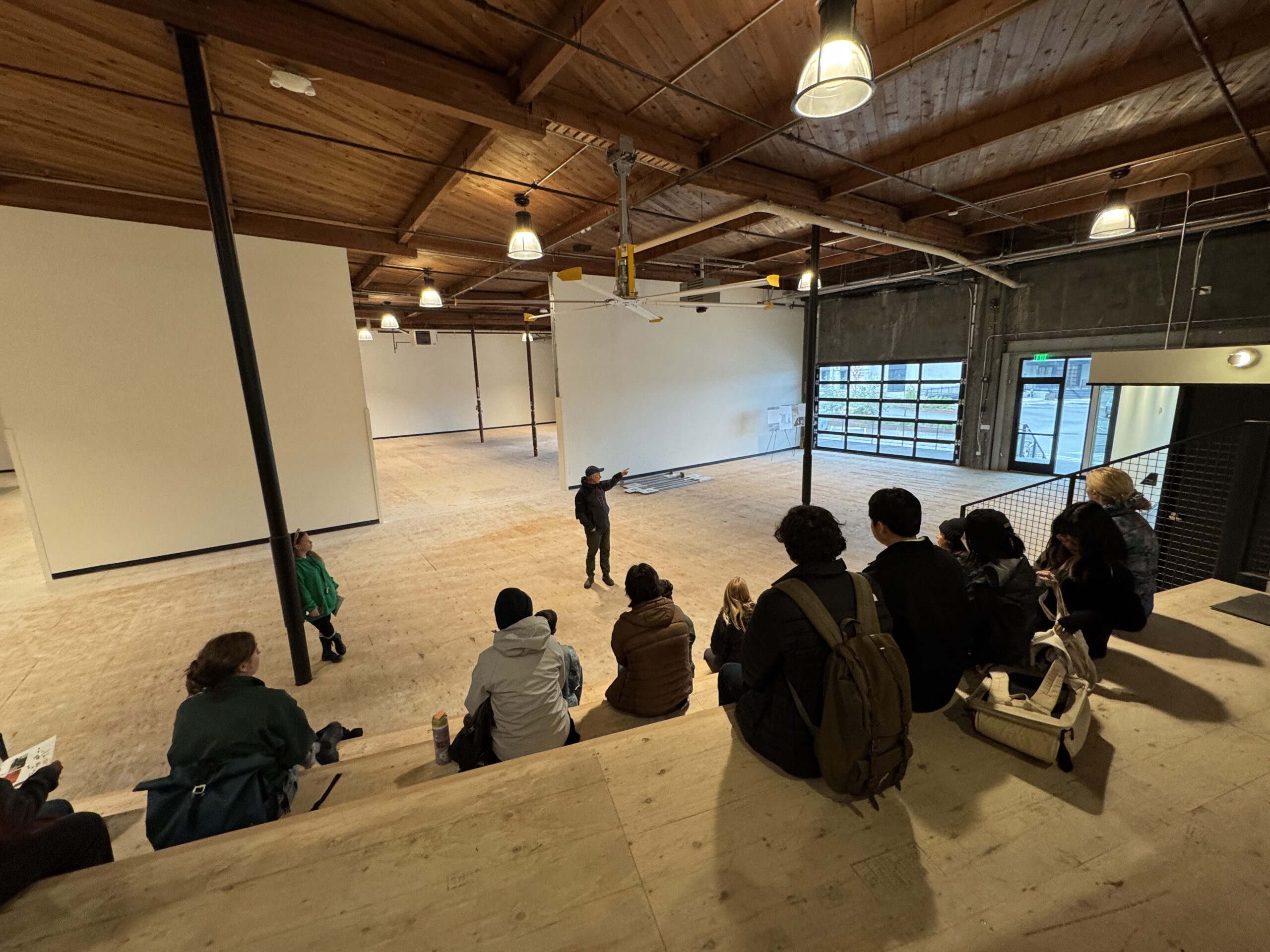
Students working on mid-term design proposals with Jim Graham
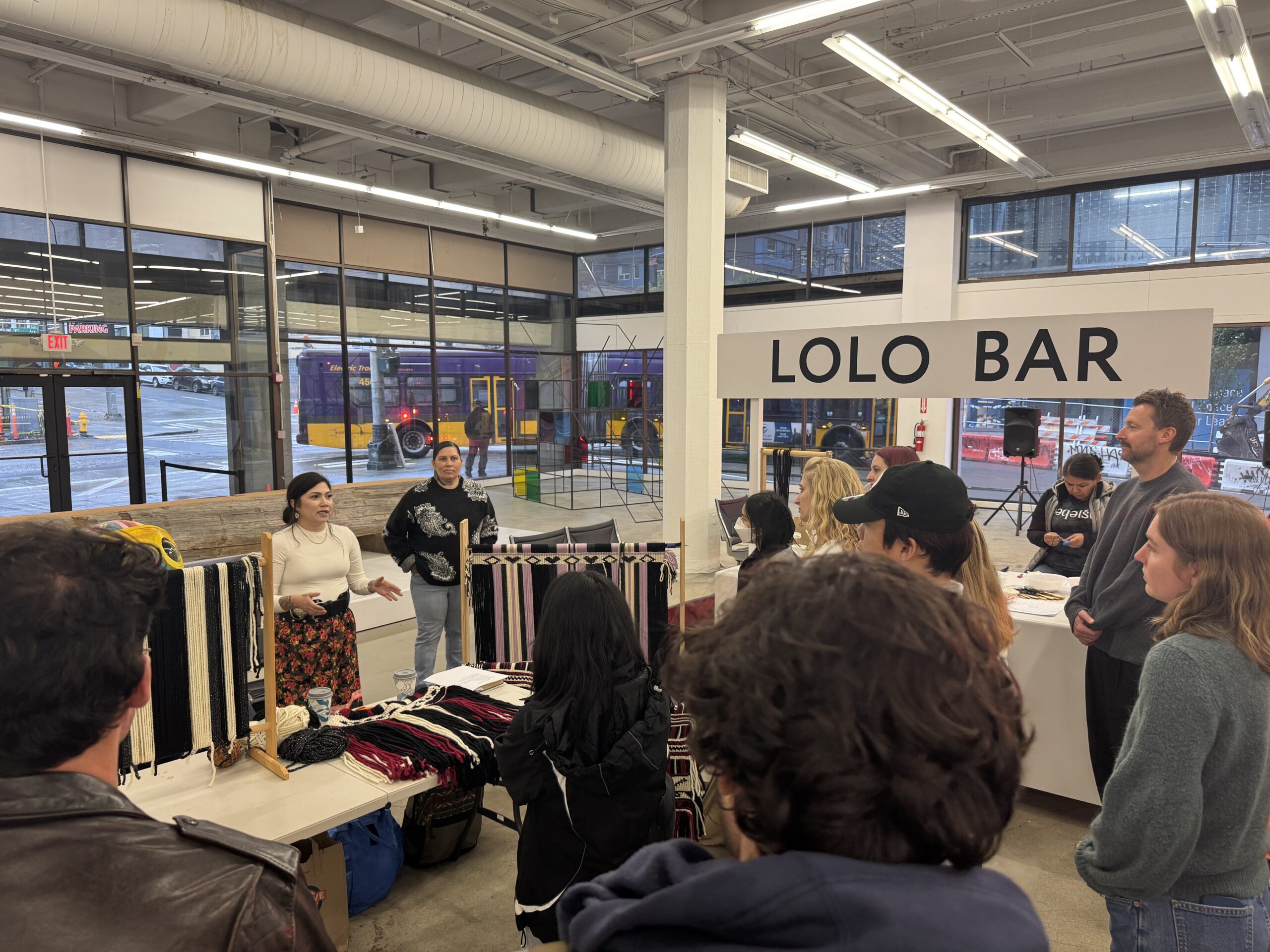
Students working with Stephanie James for long-term planning solutions
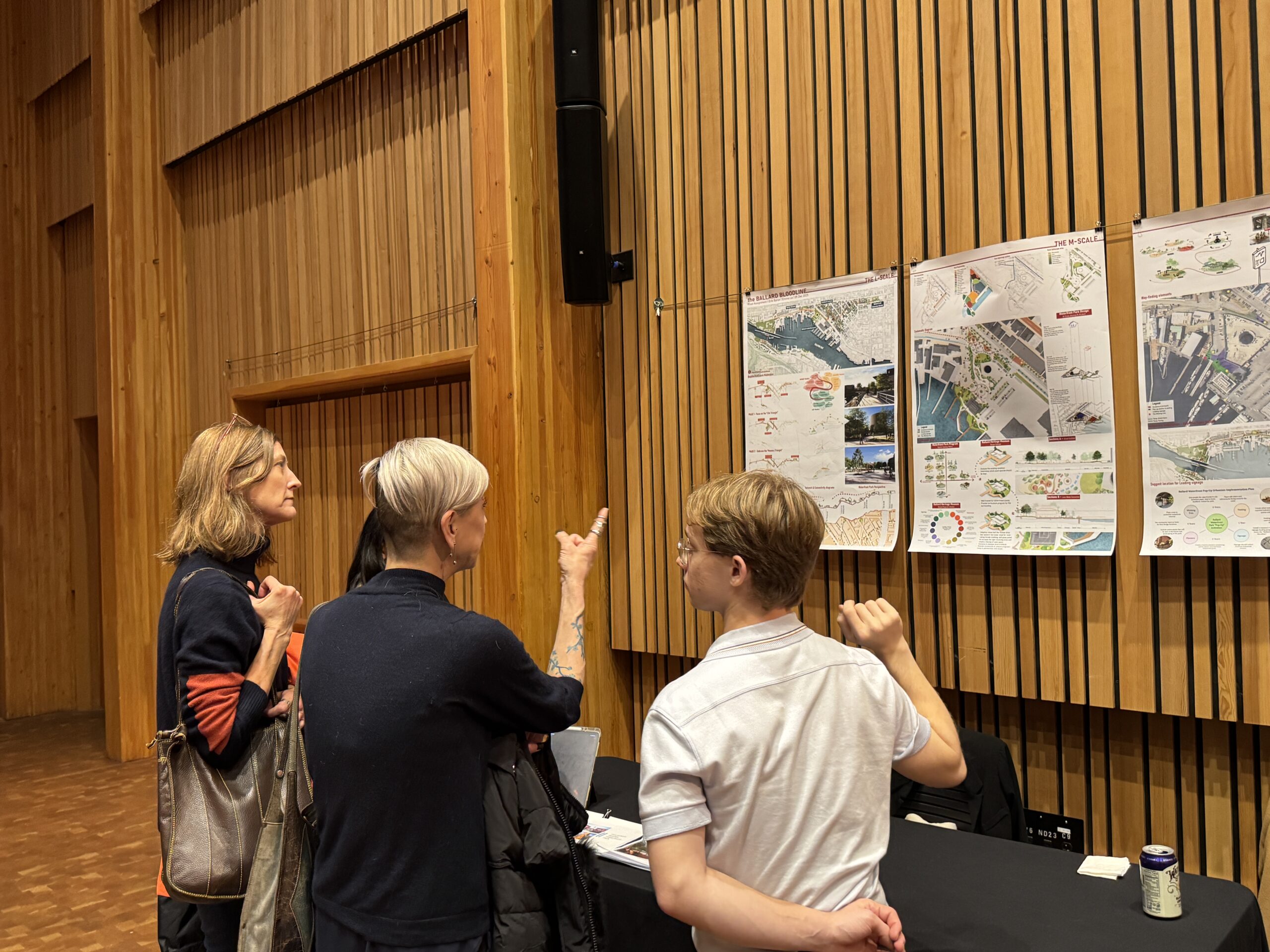
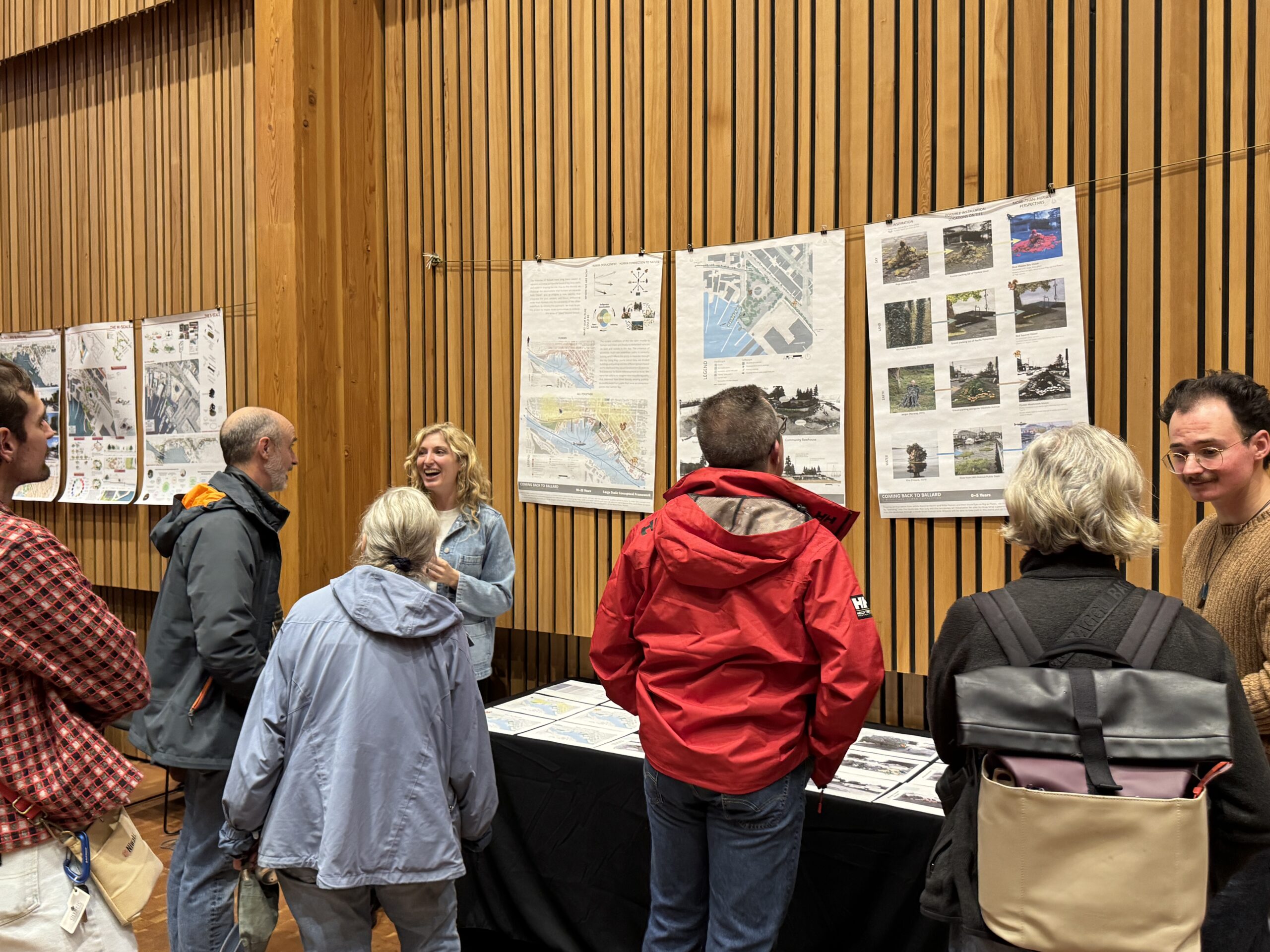
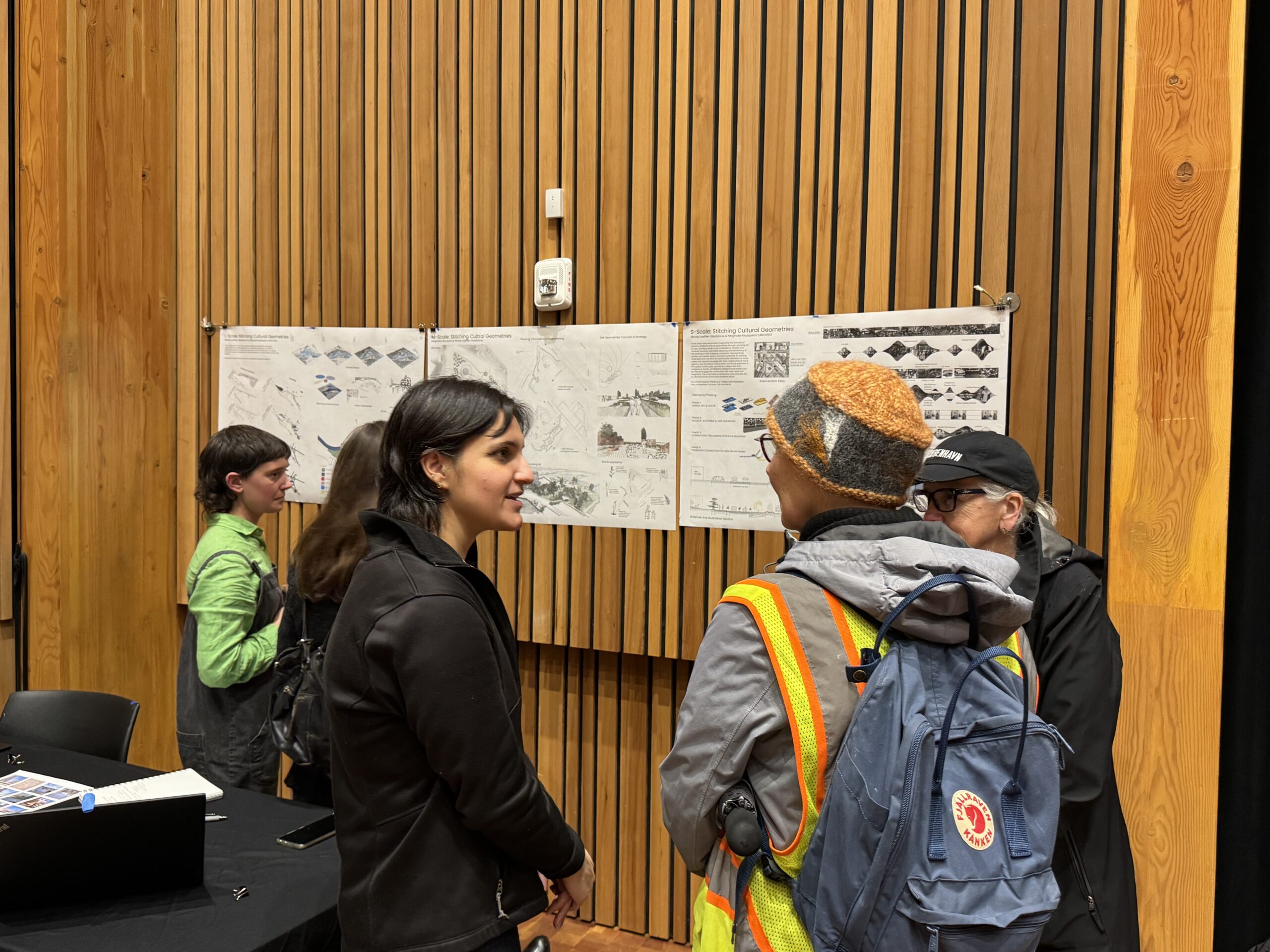
At the public review, interdisciplinary teams presented all phases together, allowing visitors to see how long-term planning, mid-term design, and near-term action formed a connected design story. Hosted in partnership with the Ballard Waterfront Park Coalition, the event highlighted ongoing efforts to expand public access and care along Ballard’s shoreline.
The December 8 review marked an invitation to continue shaping Seattle’s working waterfronts through thoughtful, community-centered design. A full studio report will be released in the new year and published on the Scan Design Studio website at https://sdstudio.be.uw.edu/.
The report will document student projects, research, and partnerships and support continued discussion around waterfront design, ecological urbanism, and civic engagement in Seattle and beyond.
Emma Le (MLA) & Erik Byron (MUP)
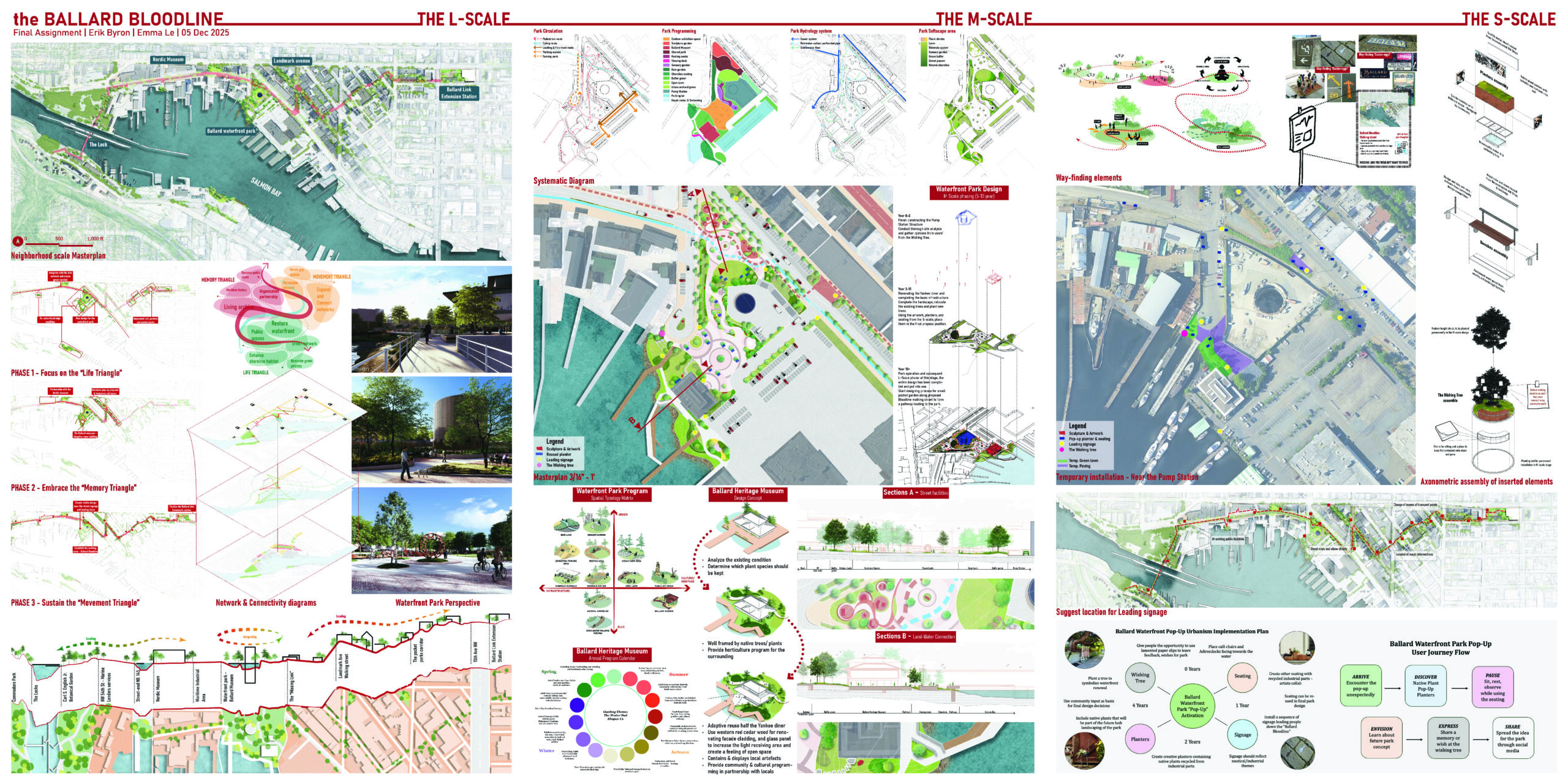
Ballard Bloodline is a proposal for a three-pronged framework that strengthens Ballard’s identity through enhanced pedestrian corridors, safe cycling infrastructure, and a central waterfront park. The project positions mobility and public art as connective tissue—linking neighborhood, city, and global maritime networks—while grounding new public spaces in Ballard’s layered cultural history. By prioritizing legibility and access, the proposal frames the waterfront as both destination and civic anchor.
Keywords: Pedestrian mobility, public art, ecological integration, transit connectivity, public space
Sydney Bostater (MLA 27) & Walter Donovan Jr. (MUP 26)
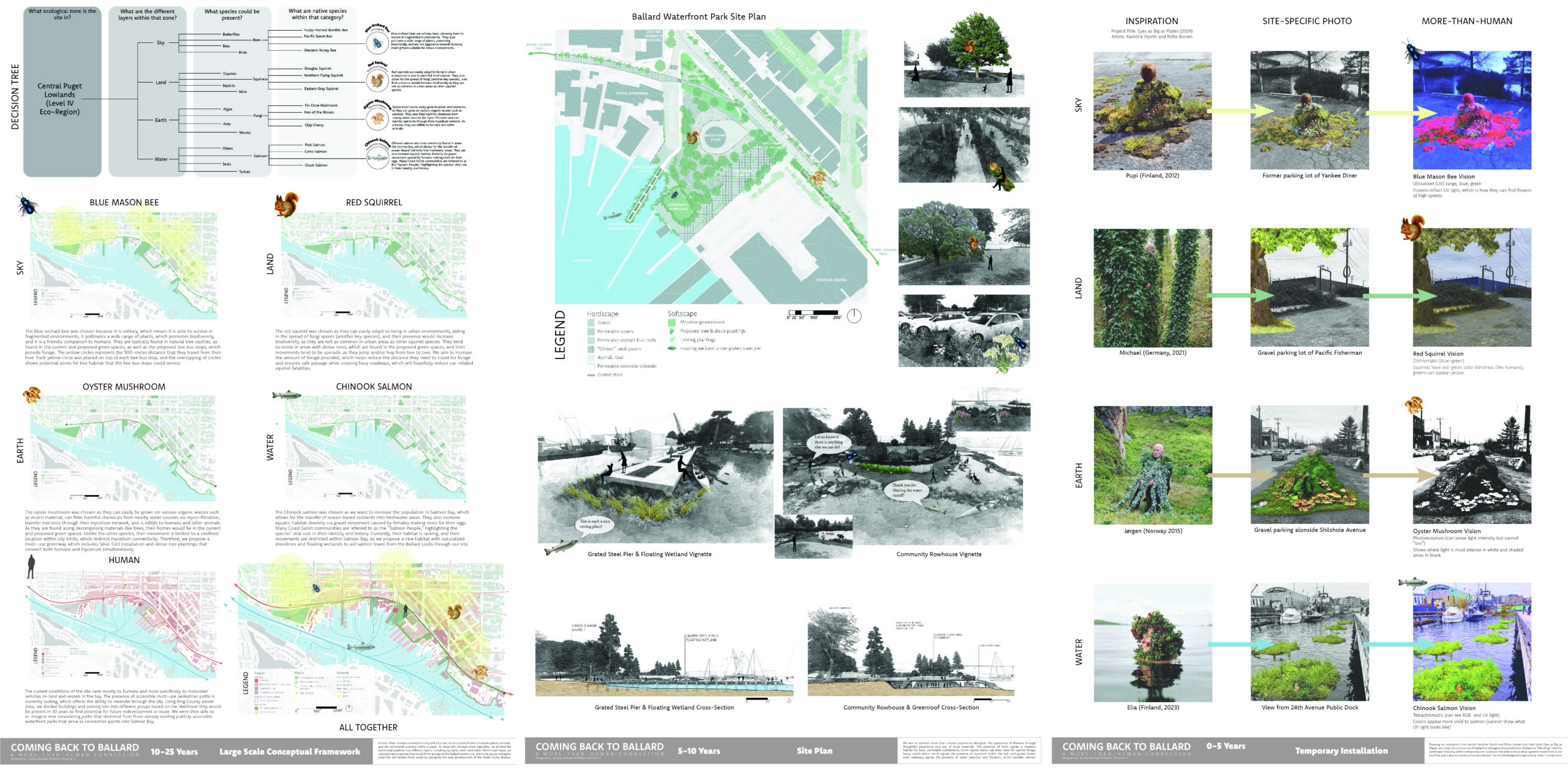
Coming Back to Ballard: A More-Than-Human Connection challenges human-centered planning narratives by foregrounding a more-than-human approach to urban waterfront design. By integrating land, water, sky, and non-human species into a circular framework, the proposal reframes Ballard’s identity as relational rather than linear. The project positions the waterfront as a shared habitat, using multi-use greenways and ecological typologies to reconnect people to place while acknowledging forces beyond human control.
Keywords: Circular systems, typologies, multi-use greenway, flâneur, more-than-human
Sheridan Heartwood (MLA 27) & Merrel Judy (MArch 26)
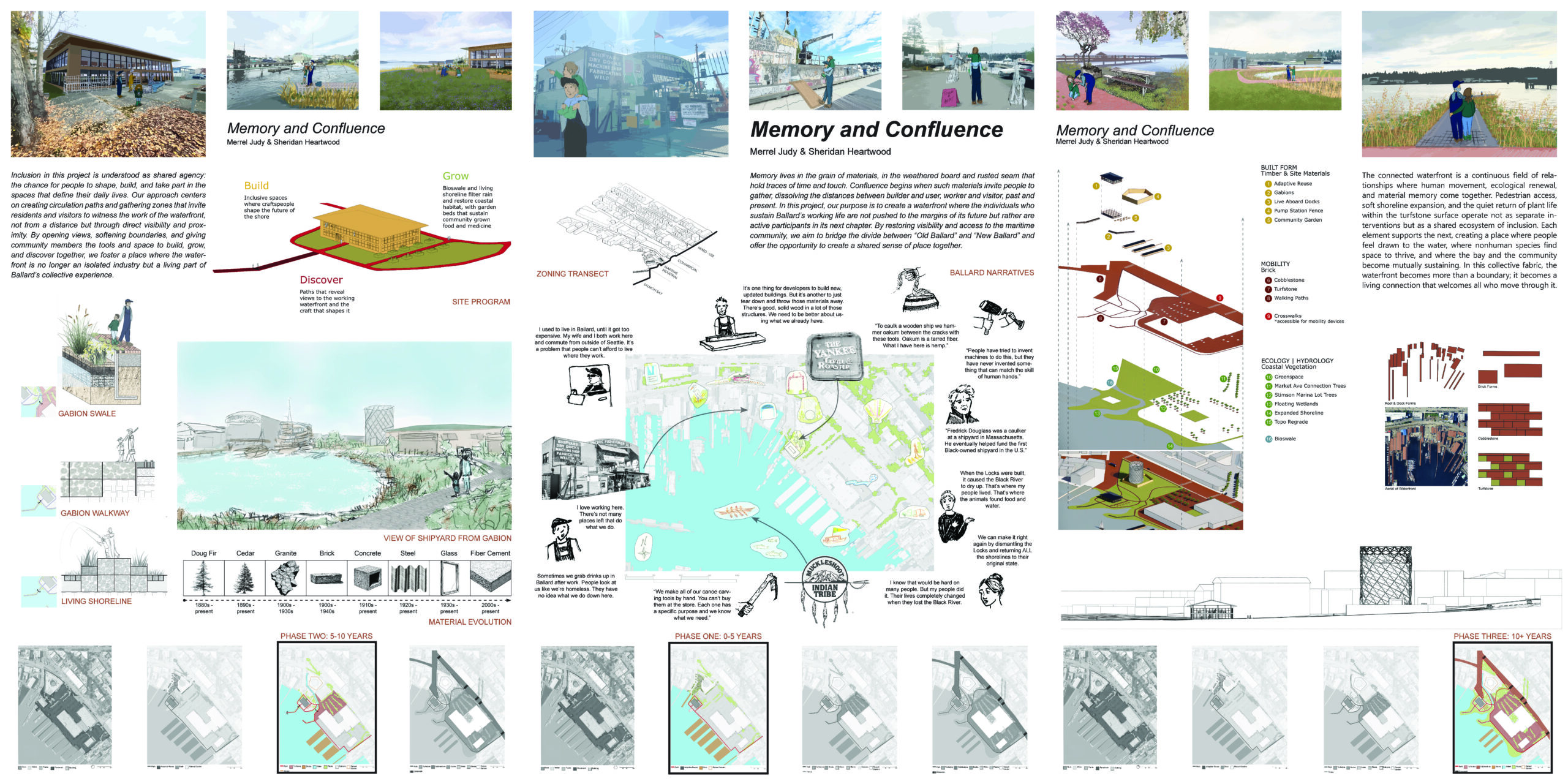
Memory & Confluence centers the lived experience of Ballard’s maritime workers, emphasizing material memory, labor, and social encounter. The project treats weathered materials and industrial remnants as active design agents—inviting gathering, participation, and discovery. By restoring visibility and dignity to the maritime community, the proposal resists displacement narratives and reframes the working waterfront as a place of shared authorship and belonging.
Keywords: Social dynamics, material evolution, participatory landscapes, sense of discovery
Jake Ephron (MLA) & Oliver Qian (MUP)
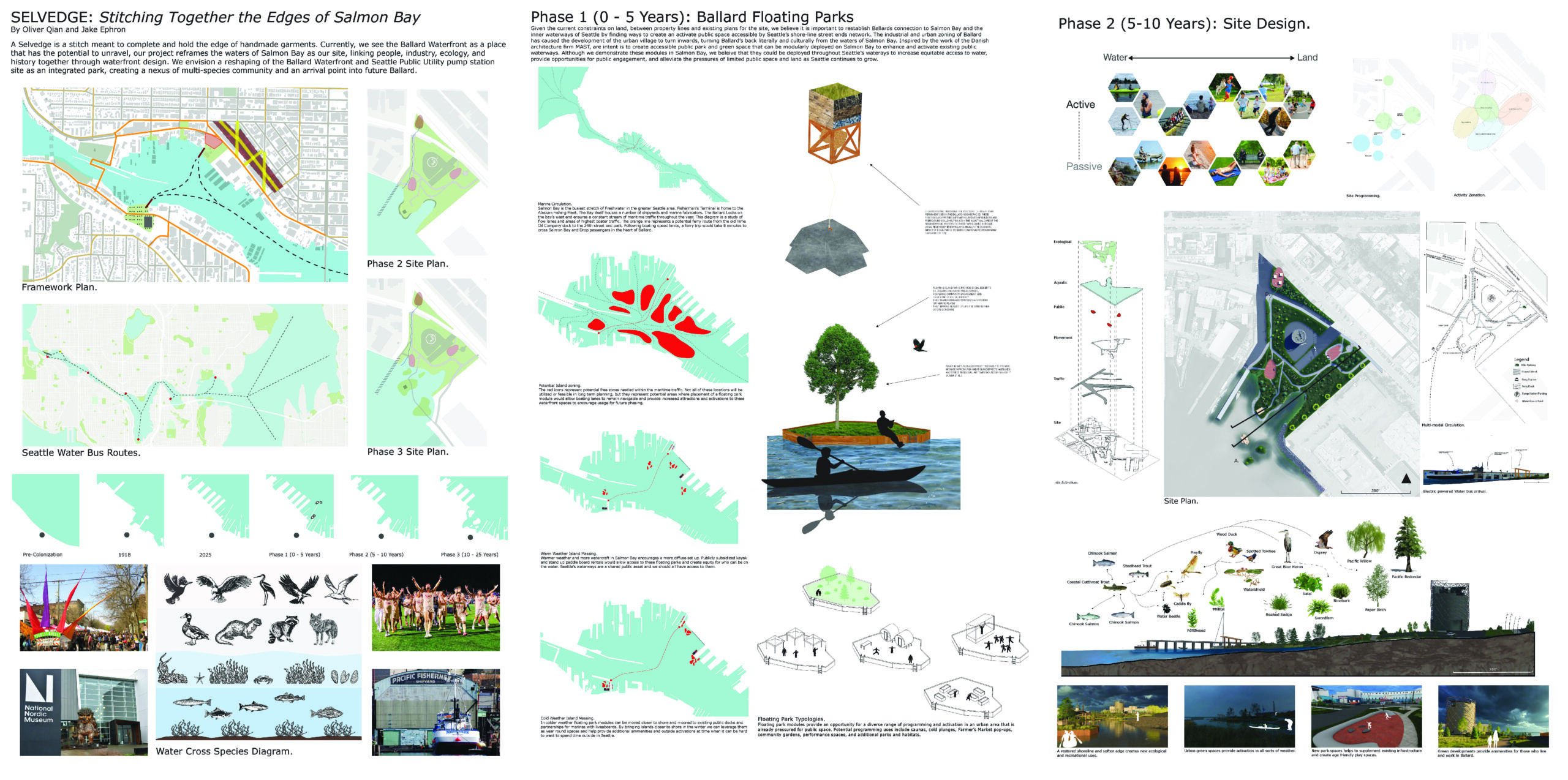
Selvedge reframes Salmon Bay itself as the primary site—understanding water as connective tissue between people, industry, and ecology. The project proposes an integrated park and shoreline system at the SPU pump station site, creating a multi-species nexus and a key arrival point into Ballard. By strengthening ecological corridors and waterfront access, the proposal positions the edge as a productive, connective landscape rather than a boundary.
Keywords: Green corridors, connectivity, housing, ferry, shoreline ecology
Nicole Loeffler-Gladstone (MLA 27) & Magnolia Mozayeni (MUP 26)
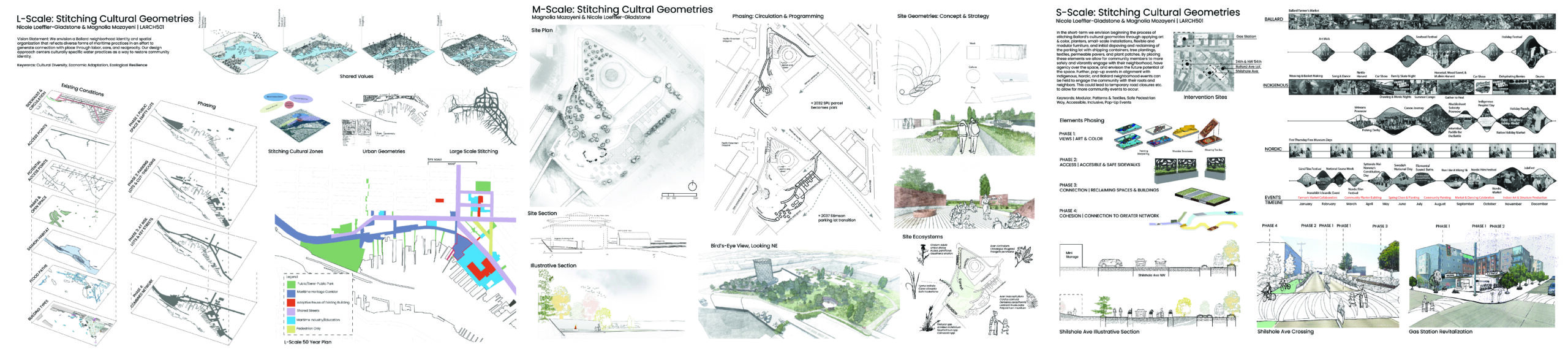
Stitching Cultural Geometries explores how culturally specific maritime practices can shape spatial organization and neighborhood identity. Stitching Cultural Geometries centers labor, care, and reciprocity as design drivers—using water-based cultural practices to generate new forms of connection and economic adaptation. The proposal imagines a waterfront that reflects Ballard’s cultural diversity while strengthening ecological resilience through culturally grounded spatial systems.
Keywords: Cultural diversity, economic adaptation, ecological resilience
Emma DeBoer (MLA 27) & Iona Cich (MUP 26)
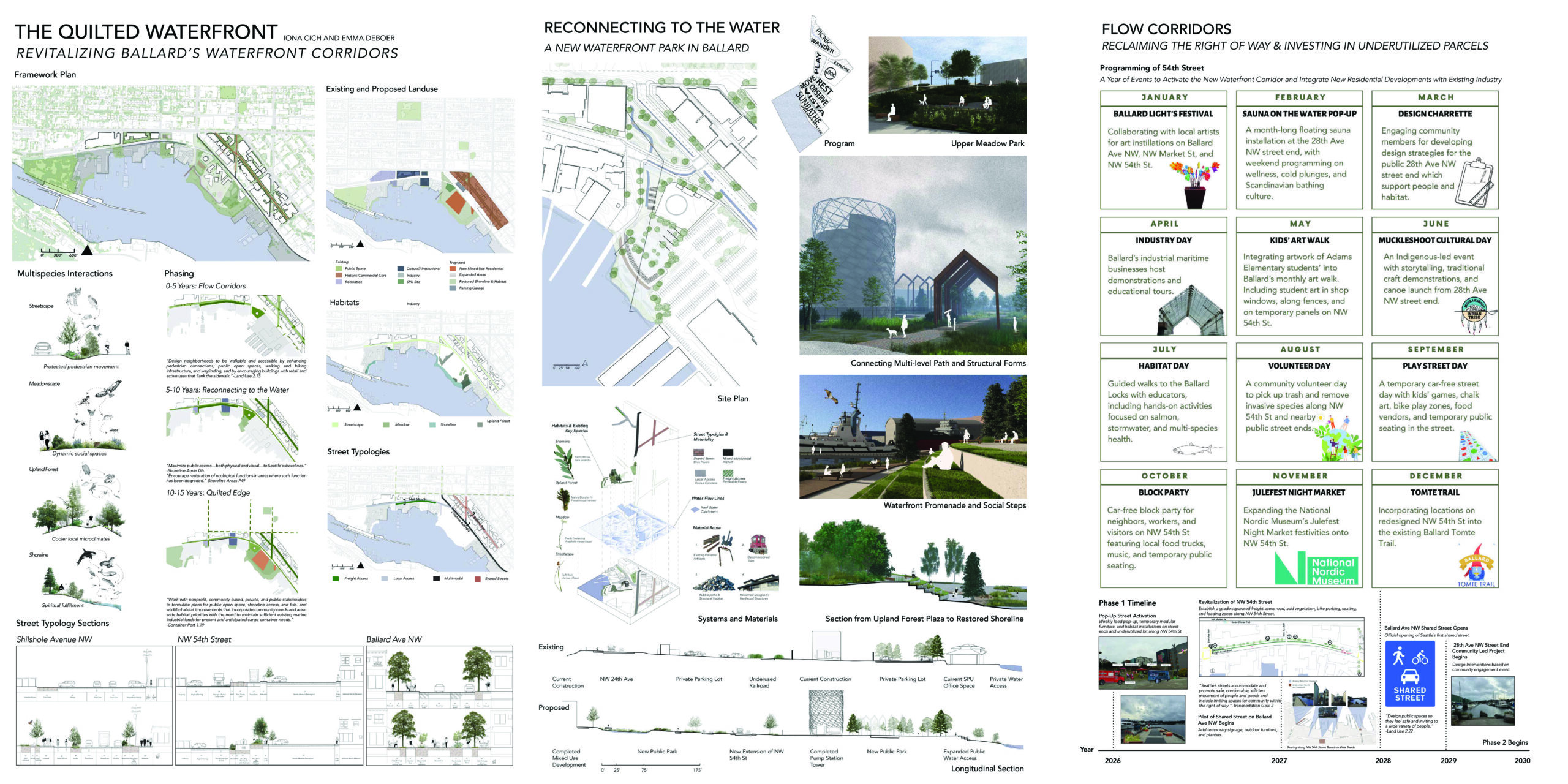
The Quilted Waterfront: Revitalizing Ballard’s Waterfront Corridors reclaims the right-of-way as a network of green, multimodal corridors that support people, water, and habitat. The project stitches together fragmented infrastructure into a continuous public landscape, emphasizing coexistence between mobility, ecology, and daily life. By treating corridors as active public space rather than leftover infrastructure, the proposal advances a more resilient and welcoming waterfront.
Keywords: Green multimodal corridors, reclaiming public space, habitat creation, coexistence
Kaylin Hui (MLA 27) & Wesley Newhart (MUP 26)
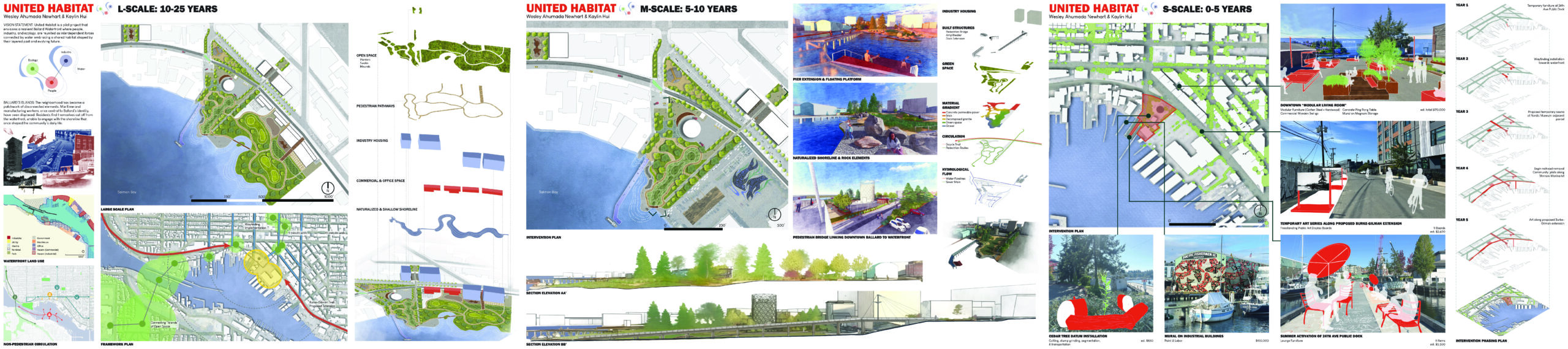
United Habitat envisions the Ballard waterfront as a shared ecological and industrial landscape where people, species, and maritime activity are reunited through water. Framed as a pilot project, the proposal emphasizes island connections, habitat creation, and the continued belonging of industry within Ballard’s future. The project argues for coexistence—not separation—as the basis for long-term resilience.
Keywords: Island connection, habitat creation, industry belonging
Taken together, the seven projects articulate the studio work as speculative yet grounded visions for Ballard’s waterfront—one that reconciles industry and ecology, honors cultural memory, and treats design as a civic and ethical practice operating across time.
The College of Built Environments extends sincere thanks to the Scan Design Foundation for its sustained commitment to interdisciplinary, international design education, and for making both the studio and study tour possible.
Additional thanks go to the many community and institutional partners including the Ballard Waterfront Park Coalition, Groundswell NW, Seattle Parks & Recreation, Seattle Public Utilities (SPU), Pacific Fishermen, the National Nordic Museum, and the Muckleshoot Indian Tribe, as well as the reviewers and practitioners who generously shared their time and expertise: