
Posted on February 20, 2026
Post categories: Architecture Climate In the Media
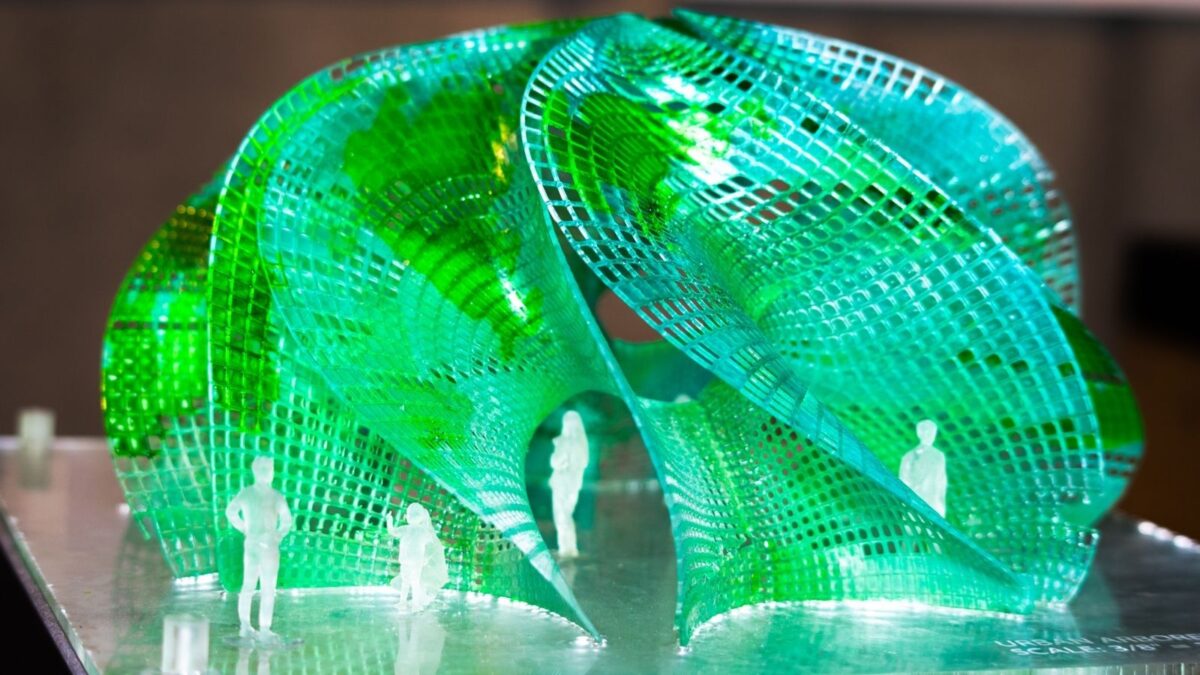
Faculty and students in chemistry, bioengineering and architecture are working side by side to explore how the built environment could function more like an ecosystem. Within the College of Built Environments, the Architecture Department is helping translate scientific discovery into spatial innovation, bridging laboratory research and real-world design. Supported by the National Science Foundation, their collaboration is creating new building materials that combine advanced fabrication with living organisms such as algae and fungi. It positions the built environment as a partner within natural cycles rather than separate from them, integrated, adaptive and responsive by design.
At its core, the work asks a simple but powerful question: What if the materials we build with could behave more like living systems, able to heal, regenerate and capture carbon dioxide instead of releasing it? In the lab, researchers are developing bio-based building materials that integrate organisms such as algae and fungi into carefully designed structures. Using advanced 3D printing, they create microscopic channels that move nutrients and fluids through the material, allowing those organisms to remain active. In studios, those breakthroughs are translated into building concepts that explore how walls, facades and infrastructure could repair themselves, safely decompose at the end of their life span or convert waste into useful energy.
The stakes are significant. Buildings and construction account for an estimated 42% of global carbon dioxide emissions worldwide. Many conventional materials require large amounts of energy to produce and are difficult to reuse. Engineering living materials opens a different path, one that looks to biology for inspiration and performance rather than extraction and disposal.
An exhibition now on view in Gould Hall brings this research into public view, featuring prototypes and student projects that make complex science tangible. It demonstrates what becomes possible when disciplines align around shared climate challenges and when students are invited into research that is expanding the boundaries of design and material science.
Watch the full presentation and read the article to explore how this collaboration is reshaping the future of the built environment.